British vs American English for Clear Business Writing
October 4, 2026 · Content Team · 6 min read

Choose British or American English according to your client's style guide, your organisation's rules and the people reading the message. Then use that choice consistently. Both varieties are valid; a useful business document also needs clear dates, accurate details and an obvious next step.
If you write for teams in London, Dubai and New York, you have probably paused over “organise” or “organize.” The spelling matters, but an ambiguous deadline can cause a bigger problem. This guide helps you review both without making everyday writing feel like an English exam.
Choose your audience before changing the spelling
Look for an existing house style first. A client's website, approved proposal template or editorial guide can settle many decisions. If those sources disagree, ask which one should govern the document rather than mixing them together.
For a UK-focused document, British English is a sensible starting point. For a US-focused document, American English usually fits. Do not assume that every company in Europe or the Middle East uses the same convention. International businesses often choose one style across several offices.
For Canada or Australia, check the local or client standard instead of treating every choice as simply British or American. The aim is to make the document familiar and consistent for its actual readers.
Check common spelling differences in context
These familiar pairs are worth scanning for in business copy:
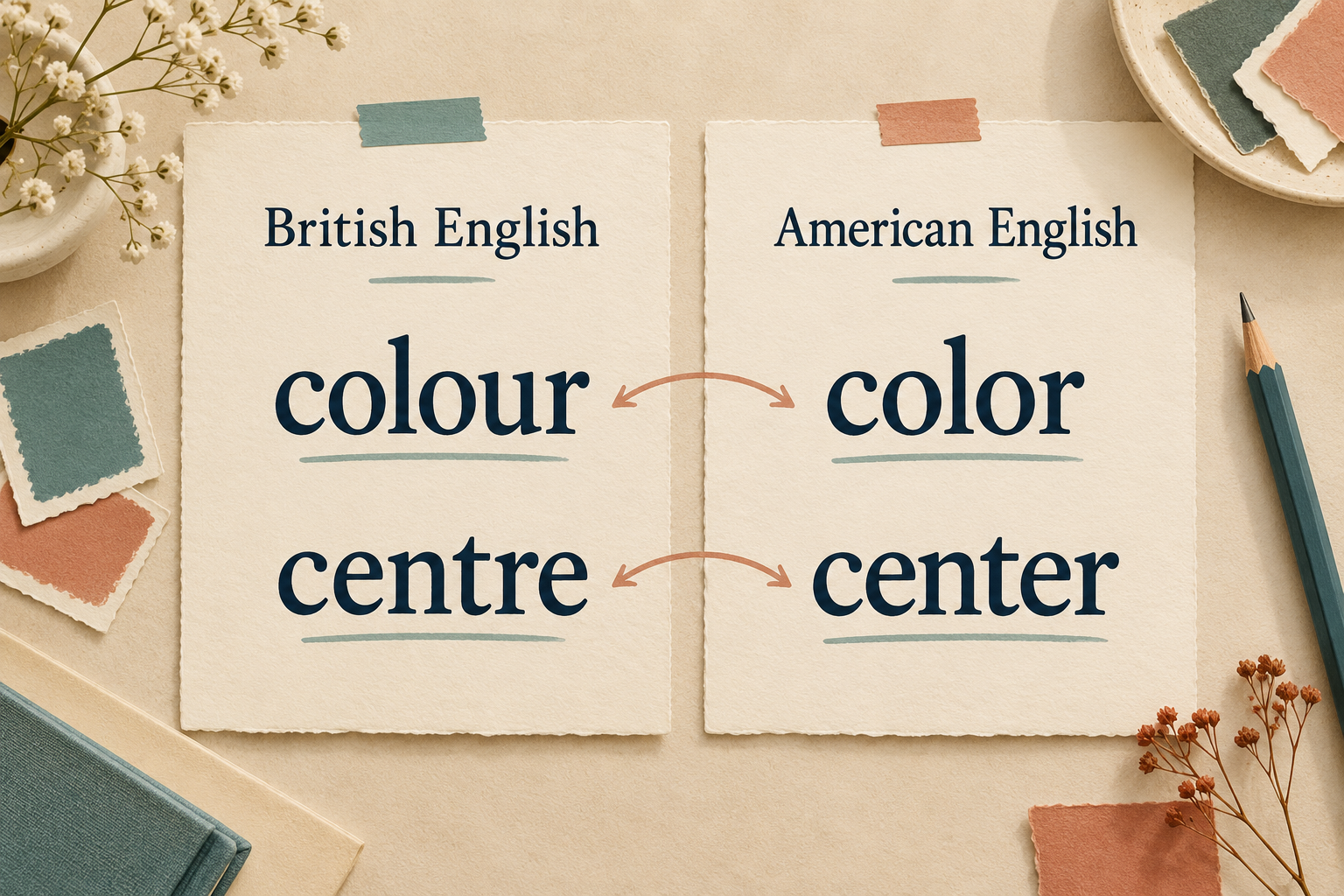
- British “colour” and American “color”
- British “centre” and American “center”
- British “favour” and American “favor”
- British “travelling” and American “traveling”
- British “analyse” and American “analyze”
Collins' spelling guide explains common patterns, but patterns have exceptions. Avoid a global find-and-replace that changes every matching letter sequence.
“Organise” is common in British English, while “organize” is standard in American English and also appears in British usage. Choose the form your house style requires. Cambridge's dictionary entry identifies “organise” as the usual UK variant.
Preserve official names and quoted wording. A company called “Harbor Analytics” should keep its registered spelling in a British-English proposal. GOV.UK's style guide makes a similar distinction between its own UK spelling and American proper nouns.
Make dates and deadlines unmistakable
A date such as 04/10/2026 can be read differently by different audiences. Write the month in words when misunderstanding would matter: “4 October 2026” or “October 4, 2026.” Either makes the intended date clear.
For an international deadline, include the time zone. “Send it by 5 pm” leaves the reader guessing which office's clock you mean. Use a verified city time or UTC offset, and check daylight-saving differences for the relevant date.
Be equally careful with currencies. A dollar sign alone may be ambiguous when colleagues work across the US, Canada and Australia. Write USD, CAD or AUD when needed. Spell out unfamiliar abbreviations on first use, particularly in instructions shared across departments.
These are editing decisions you can make regardless of which spelling convention you choose.
Review grammar without flattening the message
Some differences involve usage rather than spelling. Collective nouns are a familiar example: British writing can treat a team as a unit or as its members, depending on the meaning. American business writing generally favours singular agreement when referring to the unit.
If “the team are reviewing their individual tasks” feels awkward for your audience, write “team members are reviewing their individual tasks.” You preserve the meaning and remove the distraction.
Keep terminology accurate too. A business “programme” and a computer “program” need context in British English. Changing every instance mechanically may introduce an error.
Tone deserves a separate read. Politeness comes from a reasonable request and helpful context, not from making every sentence longer. Prefer “Could you review the attached proposal by Wednesday?” to a paragraph that hides the same request.
Use a grammar checker as a review pass
FiftyGPT's Grammar and Spell Checker provides a place to check draft text for grammar, spelling and punctuation. Paste a section, select Check Grammar, and compare the returned wording with your original.
The current form shows 15,000 characters and a free fair-use limit of 100 runs per day. Check the current allowance before a large batch. If your chosen checker offers a dialect setting, match it to your brief; otherwise review regional spelling yourself.
Keep your style notes beside the results. Accept a correction only when it fits the intended meaning, terminology and audience. A grammatically tidy sentence can still contain the wrong price, person or deadline.
See the difference in a short email
Here is a fictional draft for an international project:
“Please organize the colour samples for the new center. We need approval by 10/11 at 5. The price is $500.”
A clearer British-English version would be:
“Please organise the colour samples for the new centre. Could you approve them by 10 November 2026 at 17:00 UTC? The quoted price is USD 500.”
The rewrite chooses one spelling convention and resolves missing details. The date, year, time zone and currency are illustrative; confirm those facts before editing a real message. Language tools should never invent them for you.

Keep a short house style note
Create a small reference your team can actually use: chosen English variety, preferred dictionary, spelling exceptions, date format, currency format and approved product names. Add examples from real editing decisions as they arise.
Before sending, read the message once for meaning and once for consistency. Finish by checking the requested action. The recipient should know what to do, when to do it and where to ask a question.
Frequently asked questions
Is British or American English more professional
Both are professional. Follow the audience's expectations and your organisation's style. Consistent spelling and a clear message are more useful than treating one variety as inherently better.
Should businesses in Dubai always use British English
Check the company's own standard and the recipient's needs. Location alone does not determine a business's English style, especially when teams and customers work across several countries.
Can a grammar checker convert every spelling correctly
Do not assume it can. Proper names, quotations and context-dependent terms need review. Keep a short list of approved spellings and check suggestions against it before accepting changes.
Should I rewrite every email for a different country
Usually, follow the shared company standard unless the client or publication requests something else. Adapt unclear vocabulary, dates, currencies and deadlines whenever that helps the reader understand the message.