How to Shorten an Essay Without Losing Your Argument (2026)
Published October 27, 2026 · 8 min read
How to Shorten an Essay Without Losing Meaning
Learning how to shorten an essay without losing meaning is one of the most useful writing skills you will ever develop. Every writer overwrites the first draft — it is how ideas come out. The skill is in the revision: cutting 10, 20, even 30 percent of the words while keeping every argument, piece of evidence, and nuance intact. This guide gives you nine concrete techniques, a list of phrases to delete on sight, and a cutting workflow that works under deadline pressure.
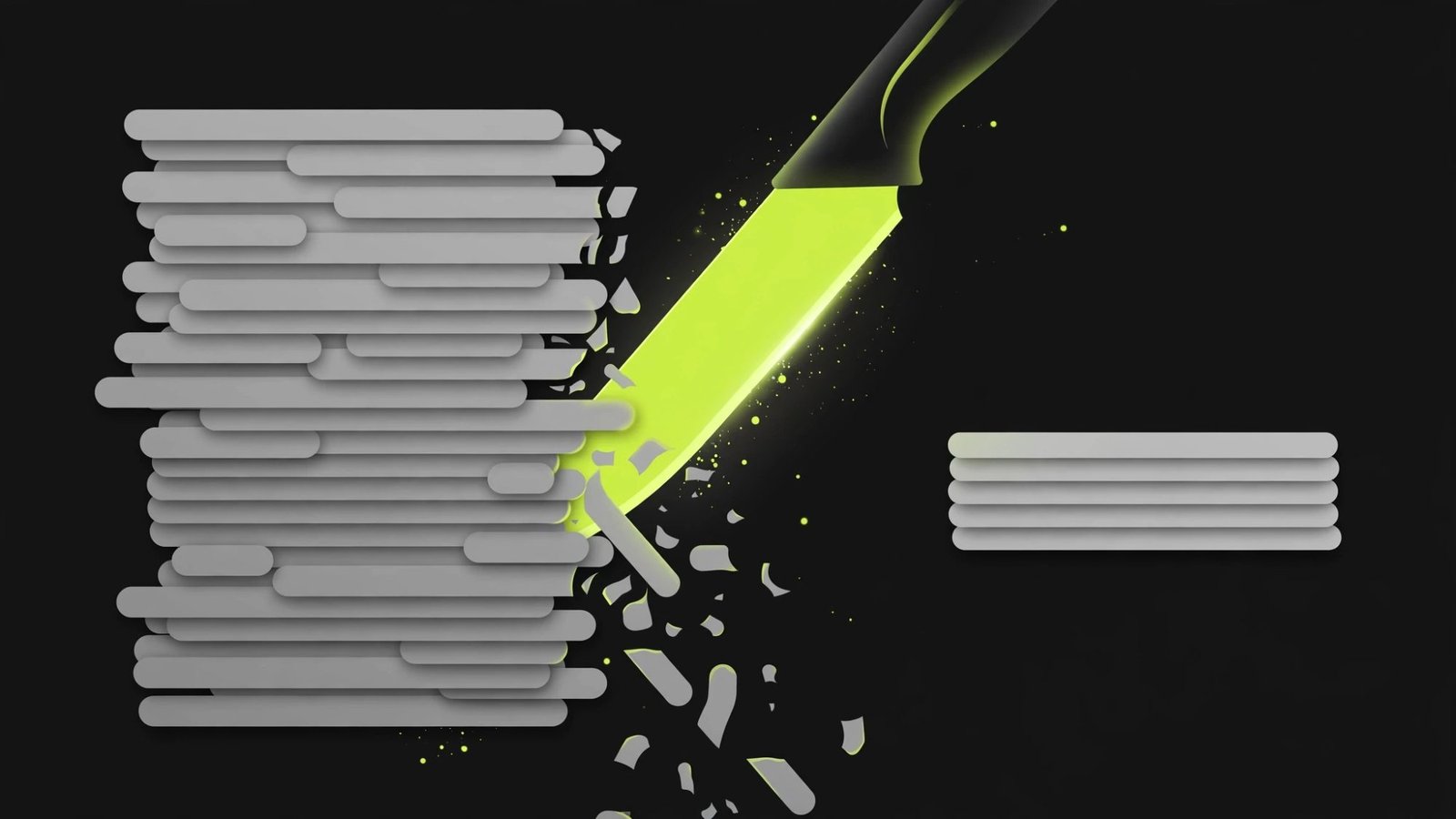
The golden rule of shortening: cut the padding, never the point. Your thesis, your evidence, your counterarguments, and your reasoning are the skeleton of the essay — untouchable. Everything else is negotiable.
1. Delete the Filler Phrases First
Some phrases add words and nothing else. Search your draft for these and delete or replace them — this pass alone typically cuts 10% of a bloated draft:
- "in order to" → "to"
- "due to the fact that" → "because"
- "in the event that" → "if"
- "at this point in time" → "now"
- "in spite of the fact that" → "although"
- "the fact that" → often deletable entirely
- "it is important to note that" → just state the thing
- "as a matter of fact" → delete
Example: "Due to the fact that the sample was contaminated, the results are invalid" becomes "Because the sample was contaminated, the results are invalid." Same meaning, five fewer words.
2. Kill "Very" and "Really"
Intensifiers almost never add information. "Very important" → "critical" or "essential." "Really difficult" → "arduous" or simply "difficult." "Very unique" is a contradiction anyway — unique is absolute. Search your document for "very" and "really" and delete or replace every one. If the sentence survives, it was padding.
3. Replace Weak Verb Constructions
Nominalizations — verbs turned into noun phrases — bloat sentences. This is the single biggest source of academic wordiness:
- "is able to" → "can"
- "make a decision" → "decide"
- "conduct an investigation" → "investigate"
- "provide assistance" → "help"
- "come to a conclusion" → "conclude"
- "in the process of" → usually deletable
"The committee made a decision to conduct an investigation" (9 words) becomes "The committee decided to investigate" (5 words). The meaning is identical; the second version is stronger.
4. Remove Redundant Pairs
English is full of doublets that say the same thing twice: "each and every," "first and foremost," "null and void," "past history," "future plans," "end result," "free gift," "added bonus." Pick one word and delete the other. Also watch for sentences that say the same thing twice in different words — "The results were surprising and unexpected" needs only one adjective.
5. Cut the Throat-Clearing Openers
First drafts usually start with warm-up sentences that say nothing: "Throughout human history, people have always wondered about..." Delete the first sentence of every paragraph and see if the paragraph survives. Often the real opening was the second or third sentence. Essays routinely lose 5% of their word count to throat-clearing intros and nothing is missed.
6. Merge Overlapping Sentences
When two sentences make the same point, combine them. "Social media increases political polarization. Studies show that algorithmic feeds expose users to more extreme content." becomes "Social media increases political polarization, as studies show algorithmic feeds expose users to more extreme content." One idea, one sentence, fewer words.
7. Tighten Transitions

Transitions should be one or two words, not a parade. "In addition to the aforementioned points, it should also be noted that" is doing the work of "also" or "furthermore." Replace bloated transitions with simple ones: however, therefore, for example, in contrast, consequently.
8. Use Active Voice (Usually)
Passive voice adds words and buries the actor: "The experiment was conducted by the researchers" → "The researchers conducted the experiment." Use active voice by default and reserve passive for moments when the actor genuinely does not matter. This alone can cut 3-5% from an academic draft.
9. Cut Whole Paragraphs, Not Just Words
If you are significantly over the limit, word-level trimming is not enough — work at the structure level. Rank every paragraph by how essential it is to your thesis. The weakest paragraph gets deleted entirely, not trimmed. An essay with five strong paragraphs always beats an essay with seven paragraphs where two are filler. Be ruthless: if removing a paragraph does not change your argument, it should never have been there.
The 20% Cut: A Worked Example
Here is a real passage cut from 118 words to 89 — a 25% reduction with zero lost meaning:
Before (118 words): "In order to fully understand the causes of the conflict, it is important to note that there were a number of different factors that all played a very significant role. Due to the fact that economic tensions had been building up for a really long time, the two nations found themselves in a situation where cooperation was no longer really possible. At this point in time, the leaders made a decision to conduct an investigation into the matter."
After (89 words): "Understanding the conflict's causes requires examining several significant factors. Because economic tensions had built for years, cooperation between the two nations was no longer possible. The leaders then decided to investigate the matter."
Every claim survived. The padding did not.
A Cutting Workflow for Deadline Night
Follow this order — it prevents the classic mistake of polishing sentences you later delete:
- Structural pass first. Delete or merge the weakest paragraphs. Aim to get within striking distance of the limit.
- Filler phrase pass. Search and destroy the filler list from technique 1, plus "very" and "really."
- Sentence pass. Tighten verbs, remove redundancies, fix transitions, convert passive to active.
- Read aloud. Your ear catches clunky leftovers your eyes skip. If you stumble, trim.
- Verify the argument. Read only your thesis, topic sentences, and conclusion. If the chain holds, you cut safely.
If you are revising a large document and want help spotting wordy constructions at scale, an AI paraphrasing tool can suggest tighter rewordings for your most bloated sentences — then you decide which suggestions keep your meaning.
What to Never Cut
When the deadline pressure hits, it is tempting to cut anything. Protect these:
- Your thesis statement — the essay's promise to the reader.
- Topic sentences — the signposts of your argument.
- Evidence and examples — the proof your claims rest on.
- Counterarguments and rebuttals — deleting them makes your essay weaker, not shorter.
- The concluding synthesis — where everything ties together.
Cut filler words, repeated phrases, throat-clearing openers, over-explained transitions, and sentences that restate what you already said. Never cut the substance that earns the grade.
Frequently Asked Questions
How can I shorten my essay quickly?
Search your draft for the filler phrases in this guide ('in order to', 'the fact that', 'very', 'really') and delete or replace them first — that alone often cuts 10%. Then go sentence by sentence: look for redundant pairs, weak verb constructions ('is able to' → 'can'), and throat-clearing openers. Finally, check for repeated points and merge them.
How do I cut words without changing the meaning?
Meaning lives in your claims, evidence, and reasoning — not in the filler around them. Deleting 'in order to' (→ 'to') or 'due to the fact that' (→ 'because') changes nothing about what the sentence says. Cut adverbs like 'very' and 'really', redundant pairs like 'each and every', and opening throat-clearing sentences. The argument stays; the padding goes.
What is the fastest way to reduce word count?
The fastest cuts are mechanical: replace 'in order to' with 'to', 'due to the fact that' with 'because', 'is able to' with 'can', 'in the event that' with 'if', and delete every 'very' and 'really'. Then remove any sentence that restates what another sentence already said. This pass typically removes 15-20% of words in under an hour.
Can I cut my essay by 20% without hurting the grade?
Usually, yes — if the cuts remove padding rather than content. Graders reward tight, precise writing; long essays full of filler score worse than shorter focused ones. Never cut by deleting whole arguments, evidence paragraphs, or counterarguments to hit a limit. Trim the words around your ideas, not the ideas themselves.
What should I never cut when shortening an essay?
Never cut your thesis statement, topic sentences, evidence and examples, counterarguments and rebuttals, or your concluding synthesis. These carry the grade. Cut filler words, repeated phrases, throat-clearing openers, over-explained transitions, and sentences that restate what you already said — never the substance.
How do I shorten an essay that is way over the limit?
For big cuts (30%+), work at the paragraph level first: rank each paragraph by importance and cut the weakest one entirely, checking the essay still flows. Merge two overlapping paragraphs. Only then do the sentence-level trimming. If you are still over after structural cuts, you may have two essays in one — split the topic rather than amputating both halves.
